Daftar Isi
Automated License Plate Readers: The Invisible Network Watching Our Roads
Explorehotelworld.com – Every time you drive past a street corner or enter a shopping center parking lot, there’s a good chance a camera is capturing your vehicle’s passage. These automated license plate readers, commonly referred to as ALPRs or LPRs, have become nearly ubiquitous across American communities. Most drivers never even notice them perched on utility poles or mounted above intersections, yet each passing car generates a digital record that joins a vast, searchable database.
How Widespread Is the Technology?
The DeFlock mapping project, which relies on community contributions and OpenStreetMap data, currently displays approximately 119,000 license plate readers throughout the United States. Since this platform depends partly on crowdsourced information, some cameras may be undercounted while others might appear in locations where they have since been relocated. Flock Safety dominates this landscape, accounting for roughly 83 percent of all mapped devices. California leads with over 16,000 registered readers, with significant concentrations visible around Los Angeles and the San Francisco Bay Area.
Law enforcement agencies have embraced this technology primarily for locating stolen automobiles and vehicles linked to serious criminal activity. However, privacy advocates caution that the same surveillance network can track the daily movements of everyday citizens. Each camera capture typically records the vehicle’s license plate number, physical appearance, geographic position, and exact timestamp of the encounter.
What Information Do These Cameras Collect?
When a vehicle drives by, the camera photographs it while software simultaneously reads the license plate and converts the image into a searchable entry. The resulting record extends far beyond the alphanumeric characters on your plate. The system documents the vehicle’s make and model, along with its color and body style. Additional visible characteristics may also be captured and made searchable, such as roof racks, bumper stickers, or even a missing hubcap.
Flock Safety emphasizes that its license plate reader technology concentrates on vehicles rather than faces. The company maintains that its LPR cameras deliberately exclude facial recognition capabilities and biometric identification features. A single camera sighting might reveal minimal information about your routine, but multiple observations can gradually construct a detailed pattern of your movements.
For instance, a vehicle appearing near the same residence each evening could indicate someone’s home location. Another record might document a trip to a healthcare facility. Furthermore, a license plate number can be cross-referenced with information maintained by state motor vehicle departments, enabling investigators to identify registered owners more efficiently.
Who Uses These Cameras and How?
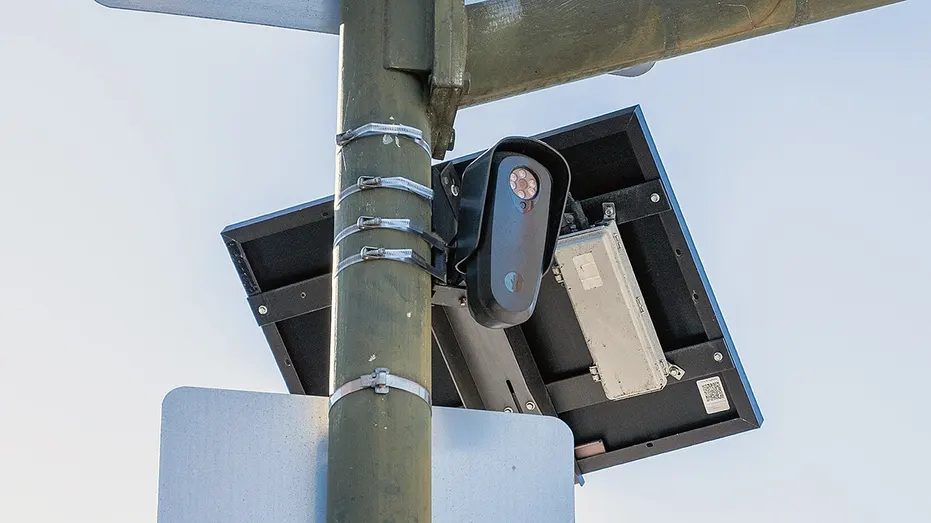
While police departments have traditionally been the primary users of automated license plate readers, businesses and homeowners associations have increasingly installed their own systems. The regulations governing these cameras vary considerably depending on ownership and data access permissions. Cameras typically appear on poles positioned near roadways, intersections, and neighborhood entrances, with some units featuring attached solar panels for power.
CyberGuy’s earlier investigation revealed that license plate cameras are also monitoring vehicles at certain Home Depot and Lowe’s retail parking lots. Flock Safety has emerged as one of the market’s leading suppliers, operating a cloud-based platform where authorized users can examine vehicle sightings. Unlike traditional red-light cameras that issue traffic citations, these readers generally focus on identification rather than enforcement.
Every vehicle that passes through a camera’s field of view potentially enters the database, regardless of whether the driver faces any suspicion or has an existing connection to an investigation. The search functionality allows authorized personnel to query by complete plate numbers, partial plate information, or vehicle descriptions. A department searching for a dark-colored SUV equipped with a roof rack might receive multiple potential matches, requiring investigators to verify their target. This capability proves particularly valuable during time-sensitive cases, though it simultaneously provides agencies with extensive access to movement data about the general public.
Related Reading
Frequently Asked Questions
What is License plate cameras are tracking drivers?
License plate cameras are tracking drivers is the main topic of this guide. The article explains the context, practical details, and next steps readers should understand.
Why does License plate cameras are tracking drivers matter?
License plate cameras are tracking drivers matters because readers are looking for a useful answer, not just a short summary. Good content should match search intent and help them decide what to do next.