The History Behind the U.S. Competition with China
The history behind the U S competition – As the 21st century unfolds, the United States and China find themselves locked in a multifaceted rivalry spanning military, technological, and strategic domains. This contest, rooted in decades of evolution, has taken on new urgency in recent years, particularly with the U.S. seeking to maintain its global edge. The roots of this competition, however, stretch back much further, to the pivotal decisions made by leaders like President Richard Nixon in the 1970s.
A Shift in Global Power Dynamics
Nixon’s historic visit to China in 1972 marked a turning point in international relations. By establishing diplomatic ties, he opened the door to a new era of collaboration and competition. Yet, this moment coincided with China’s growing influence on the world stage. Former People’s Liberation Army Senior Colonel Zhou Bo, now a Senior Fellow at Tsinghua University’s Center for International Security and Strategy, reflects on this duality. “China’s rise is not a question of if, but when,” he remarked. “It is not rising—it is already risen. The debate lies in how it will assert itself.”
“When China celebrates its centenary of the People’s Republic, that is the goal for us to become world-class military by 2049. That means we believe we can only catch up with the United States militarily by that time,” Zhou added.
China’s military trajectory began under Chairman Mao Zedong, who expanded the People’s Army to over 6.5 million troops. However, the shift toward modernization started with Deng Xiaoping’s leadership. Emphasizing quality over sheer numbers, Deng initiated reforms that prioritized technological advancement. This strategic pivot laid the foundation for China’s current military capabilities, which now rival those of the United States in critical areas.
From Troop Size to Technological Supremacy
While Mao’s era saw a focus on quantity, Deng’s reforms introduced a new dimension. By reducing troop numbers and investing in advanced weaponry, China positioned itself for a more agile and technologically sophisticated force. Over the decades, the country has significantly bolstered its naval presence, nuclear arsenal, and missile capabilities. These developments have not only strengthened its military posture but also intensified the competition with the U.S.
One notable milestone in this effort was the 2007 anti-satellite (ASAT) test conducted by the PLA. Using a ground-based missile, they destroyed a defunct weather satellite in low Earth orbit. “We definitely have this kind of capability, called ASAT capability, of launching missiles to target satellites,” Zhou noted. “In space, the question is, it’s very difficult to say what is a weapon and what is not.”
The Space Race and Strategic Rivalry
The PLA’s ASAT demonstration highlighted the growing militarization of space, a domain where the U.S. and China are now vying for dominance. Zhou Bo described this as an inevitable extension of China’s global ambitions. “I think the Chinese position is very easy to understand,” he said. “We have so many troubles on Earth, and why should we even have weapons in space to strike on our own homeland? It sounds so, so silly, right?”
“So far, no country has claimed that they have placed weapons in space. But I think it is not a secret that this is another domain for space superiority,” Zhou explained.
Analysts note that China’s space program, closely tied to its military, has become a focal point of strategic competition. The U.S. remains concerned about the potential for China to gain an advantage in orbital warfare or satellite interference. Meanwhile, China views its space efforts as a means to secure long-term technological and military dominance, with the 2049 centenary of the People’s Republic serving as a key benchmark.
Technological Innovation and the AI Front
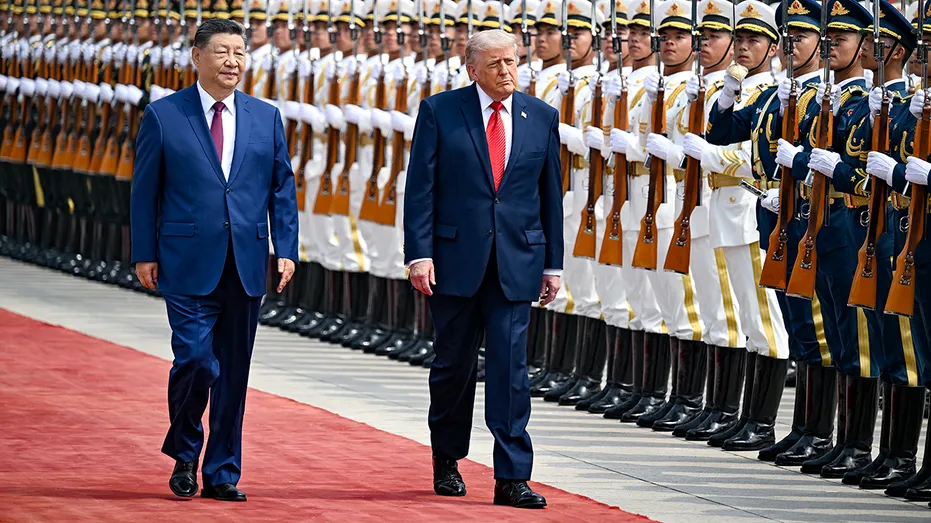
As the competition moves beyond traditional military domains, technology has emerged as a central battleground. President Donald Trump, during his visit to Beijing, asserted that the U.S. is still ahead in this race. “We’re leading China,” he stated on Special Report. “We’re leading China by a lot.” However, his recent executive order on Artificial Intelligence signals a recognition of China’s rising influence in the field.
The order grants the federal government authority to review advanced AI systems before public release, a move designed to safeguard U.S. innovation. Yet, Trump had previously delayed a similar policy, fearing it might hinder progress against China. “The U.S. has a system that really works well in the U.S., but China has a system that works well in China, but doesn’t mean the two systems cannot parallel develop,” said Henry Wang, founder and president of the Center for China and Globalization.
“China sees its efforts to track and monitor citizens as a benefit to training AI models,” Wang added. “You have 1.4 billion people, 1.1 billion smartphone users, and a large application scene. So, I think in terms of data generating, China probably is the richest.”
While China leverages its vast population and data infrastructure to fuel AI advancements, the U.S. maintains a lead in innovation. “We do have some advantages,” Wang acknowledged. “But of course, the U.S. has also a lot of innovation, and several of the largest AI companies are based in the U.S.” This dynamic underscores the need for collaboration, as experts within China argue that global cooperation is essential for effective AI regulation.
Towards Strategic Stability
Despite the tensions, both nations recognize the importance of strategic stability. Henry Wang emphasized that the competition has evolved from mere rivalry to a shared goal of maintaining balance. “We’re not talking about strategic rivalry anymore, we talk about strategic stability and China and the U.S. should achieve strategic stability not only for the benefit of both countries but for the world,” he said.
As China continues to expand its technological and military reach, the U.S. remains determined to counter its ascent. The interplay between these two superpowers shapes not only their bilateral relationship but also the broader geopolitical landscape. Whether in space, AI, or military capabilities, the race for supremacy is far from over, with each nation adapting its strategies to secure its position in an increasingly competitive world.
From Nixon’s diplomatic overtures to Trump’s AI-focused policies, the U.S.-China rivalry has evolved in tandem with the global order. While China’s rise presents challenges, it also offers opportunities for cooperation. As the two nations navigate this complex relationship, the balance of power will continue to shift, influenced by their respective priorities and the ever-changing dynamics of international competition.