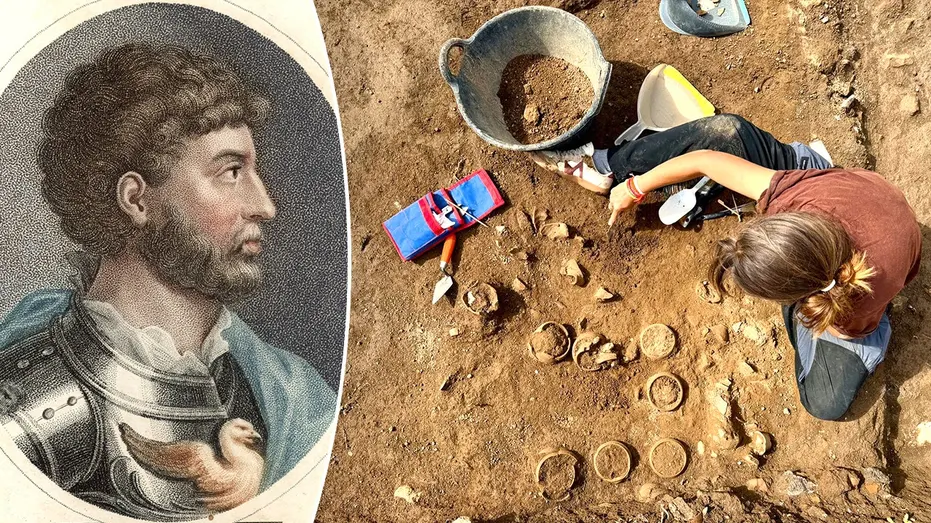
Ancient Roman Chamber Discovered Beneath Emperor Hadrian’s Imperial Estate
Hidden underground chamber revealed beneath home – Archaeological researchers have recently uncovered a concealed underground chamber located beneath an estate connected to one of ancient Rome’s most celebrated emperors. According to experts, this newly revealed structure may represent the oldest known building at the entire site. The remarkable discovery was made at Hadrian’s Villa, a sprawling imperial complex situated in Tivoli, Italy. The findings were officially announced by Pablo de Olavide University, commonly referred to as UPO, which is located in Seville, Spain.
The imperial villa served as the residence for Emperor Hadrian, who governed the Roman Empire from 117 to 138 A.D. During his reign, Hadrian became renowned for constructing Hadrian’s Wall in northern Britain and for his extensive travels throughout the vast territories of the Roman Empire. Today, this magnificent complex has been preserved as a UNESCO-listed World Heritage site, attracting both tourists and researchers from every corner of the globe.
Uncovering a Pre-Roman Republic Structure
While exploring the villa grounds, archaeologists identified an underground structure that dates back to the Roman Republic period, which lasted from 509 B.C. to 27 B.C. This timeline places the building centuries before Hadrian assumed control of the empire. Officials believe the abandoned structure may have originally functioned as a silo or storage facility for agricultural products and other valuable goods.
The chamber was partially filled with ancient construction debris and ceramic materials, suggesting it had been sealed off at some point in history. According to statements released by the research team, this discovery “could prove to be the oldest structure ever identified at Hadrian’s Villa.” Much of the earlier complex was destroyed during the construction of the emperor’s expansive villa, leaving archaeologists with limited evidence about its original history and purpose.
“The discovery is particularly significant because it is associated with a villa that predated Hadrian’s imperial residence and was later partially incorporated into the construction of the Palazzo,” the statement added.
Archaeological Findings and Preservation
Rafael Hidalgo, who serves as the director of the Palazzo Project at Hadrian’s Villa, expressed surprise that the structure was not completely filled with soil. During his team’s excavation of the interior space, they uncovered numerous objects that “provide highly valuable information for understanding the history of Hadrian’s Villa,” Hidalgo explained in an email that was translated from Spanish to English.
“The recovery of a significant assemblage of archaeological materials from inside the structure … will allow us, once the ongoing study is completed, to propose a date for this archaeological context,” he continued. “That will be of great importance in establishing the chronology of the earlier villa and determining the period during which it was occupied.”
Among the artifacts discovered were several ceramic pieces along with architectural terracottas that once adorned the roof of a nearby building. Several of these terracotta decorations featured canine heads, while one prominently depicted a bull’s head. Hidalgo noted that the structure remains in “excellent condition,” particularly its vaulted roof, which is typically fragile and prone to collapse over time.
“Even on the inner surface of the vault, the impressions left by the wooden centering — the timber framework used during construction — are still clearly visible,” said Hidalgo.
The archaeologist explained that these wooden supports “were perfectly preserved” and “supported the opus caementicium [or] Roman concrete, as it was poured to create the vault.” This preservation of construction techniques provides valuable insights into ancient building methods.
Broader Archaeological Context
Hidalgo emphasized that this discovery helps fill a longstanding gap in expert knowledge about the villa that existed before Hadrian’s time. “We have relatively little information about this earlier villa because much of it was destroyed by Emperor Hadrian during the construction of his own complex,” he stated.
This finding adds to an increasingly impressive collection of underground archaeological discoveries that shed light on ancient Roman civilization. Earlier this year, Italian authorities revealed the remains of an ancient Roman villa discovered beneath a high school gymnasium near Rome’s famous Colosseum. Additionally, last summer’s excavations for Rome’s Metro Line C project led archaeologists to uncover a multi-story apartment building dating back to the first century B.C.
These cumulative discoveries continue to reshape our understanding of ancient Rome’s urban landscape and the layers of history that lie beneath modern cities. The chamber at Hadrian’s Villa represents not only a significant addition to archaeological knowledge but also a testament to the enduring legacy of one of Rome’s most influential emperors and the civilizations that preceded him.