
A ‘Wuthering Heights’ adaptation as shallow as a puddle glittering in the sun
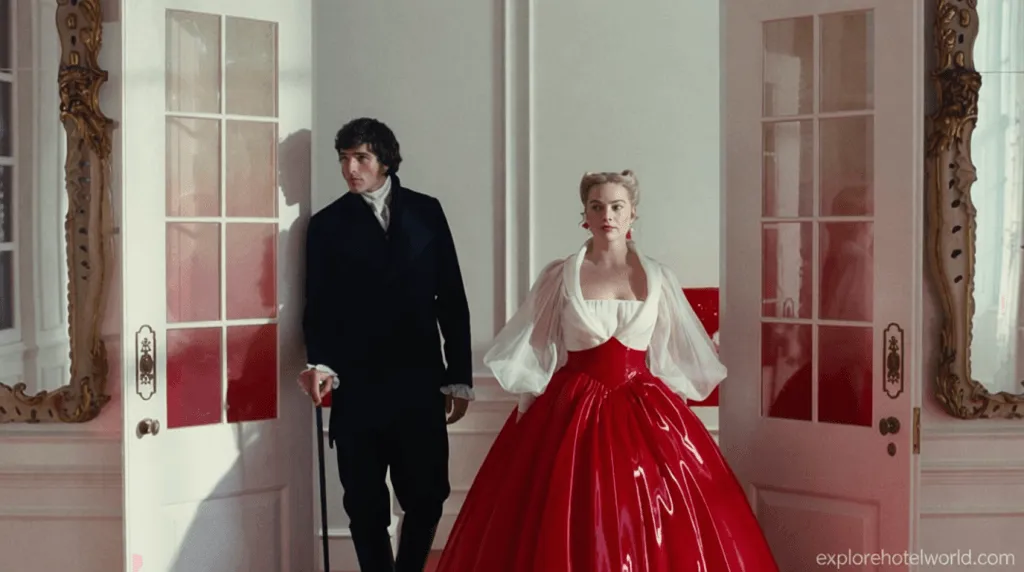
Emerald Fennell’s “Wuthering Heights”
To fully appreciate Emerald Fennell’s Wuthering Heights, one must allow its visuals to envelop them. Every droplet of rain, every flicker of light on costume fabric, every glint of a character’s eye—these elements are crafted to linger on the surface, avoiding depth in favor of sensory immersion. Fennell’s third feature film, set for release this Friday, has stirred mixed reactions since its debut trailer. Like previous filmmakers attempting to translate Emily Brontë’s wild Yorkshire moors to the screen, she chose to reimagine only the novel’s first half, truncating the narrative before the romance transforms into a psychological exploration of inherited anguish.
Fennell’s adaptation strips the story down, retaining approximately half the original plot and characters while amplifying explicit content. This includes frequent instances of oral intimacy, masturbation scenes, and sexual tension. The film’s very title, encased in quotation marks, was a deliberate move to preempt criticism. As Fennell explained during its press tour, “I can’t say I’m making Wuthering Heights, it’s not possible. What I can say is I’m making a version of it.”
Look of the Week: Margot Robbie’s Victorian Glamour
During the promotional phase, Margot Robbie, who stars as Cathy Earnshaw, embodied the film’s aesthetic with a striking Victorian wardrobe. The quotation marks around the title were not just stylistic choices but a nod to cinematic history. Mid-20th-century trailers often featured titles in quotation marks to distinguish them from crowded text on posters or as a remnant of silent film conventions. By reviving this practice, Fennell signaled her film’s connection to visual storytelling traditions rather than strict adherence to Brontë’s setting.
Her 1939 Hollywood counterpart, William Wyler, had already transformed the novel into a romantic spectacle with opulent costumes and dramatic flair. Fennell’s 2026 reimagining, designed by Jacqueline Durran, channels the same extravagance, blending mid-century fashion with a modern sensibility. Cathy’s wardrobe alone consists of 50 meticulously crafted outfits, echoing the theatricality of the era.
Period Accuracy as a Concept
Fennell and Durran’s approach to historical authenticity is unconventional. “We all think we’re making a period drama to a point, and then it just looks like the ‘90s or whenever it was made,” Fennell remarked in a recent Q&A at London’s Victoria and Albert Museum. “We are making costumes. We’re making a film. That’s a suspension of disbelief that is important to acknowledge.”
“We all think we’re making a period drama to a point, and then it just looks like the ‘90s or whenever it was made,” said Fennell during a Q&A at London’s Victoria and Albert Museum. “We are making costumes. We’re making a film. That’s a suspension of disbelief that is important to acknowledge.”
The film’s visual references span from Scarlett O’Hara in Gone with the Wind (1939) to Donkey Skin (1970), reflecting a deliberate nod to mid-century cinema. This choice underscores Fennell’s focus on style over strict historical fidelity, creating a narrative that feels both timeless and contemporary.
